
Hacker’s Guide to Tea

Posted on November 22nd, 2010. Written by Tony Gebely.

Hwang Cha Yellow Tea

Korean Hwang Cha (Yellow Tea)

TL;DR:

  • All tea comes from the camellia sinensis plant. If you are drinking something that did not come from this plant (chamomile, mint, tulsi, rooibos, etc. it is not tea).
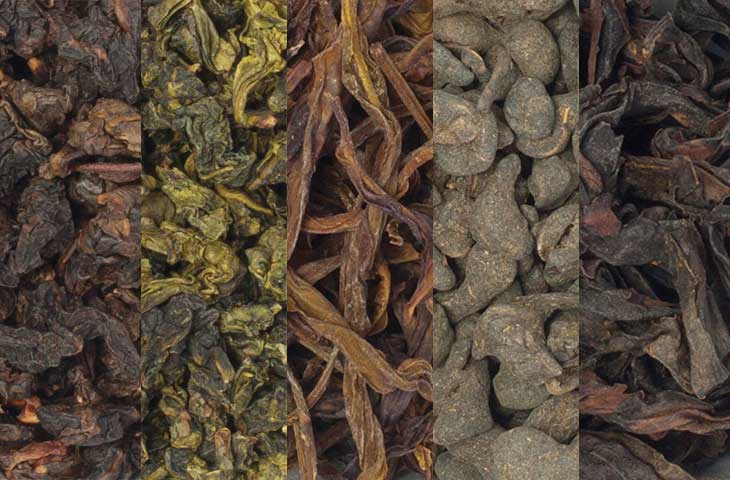
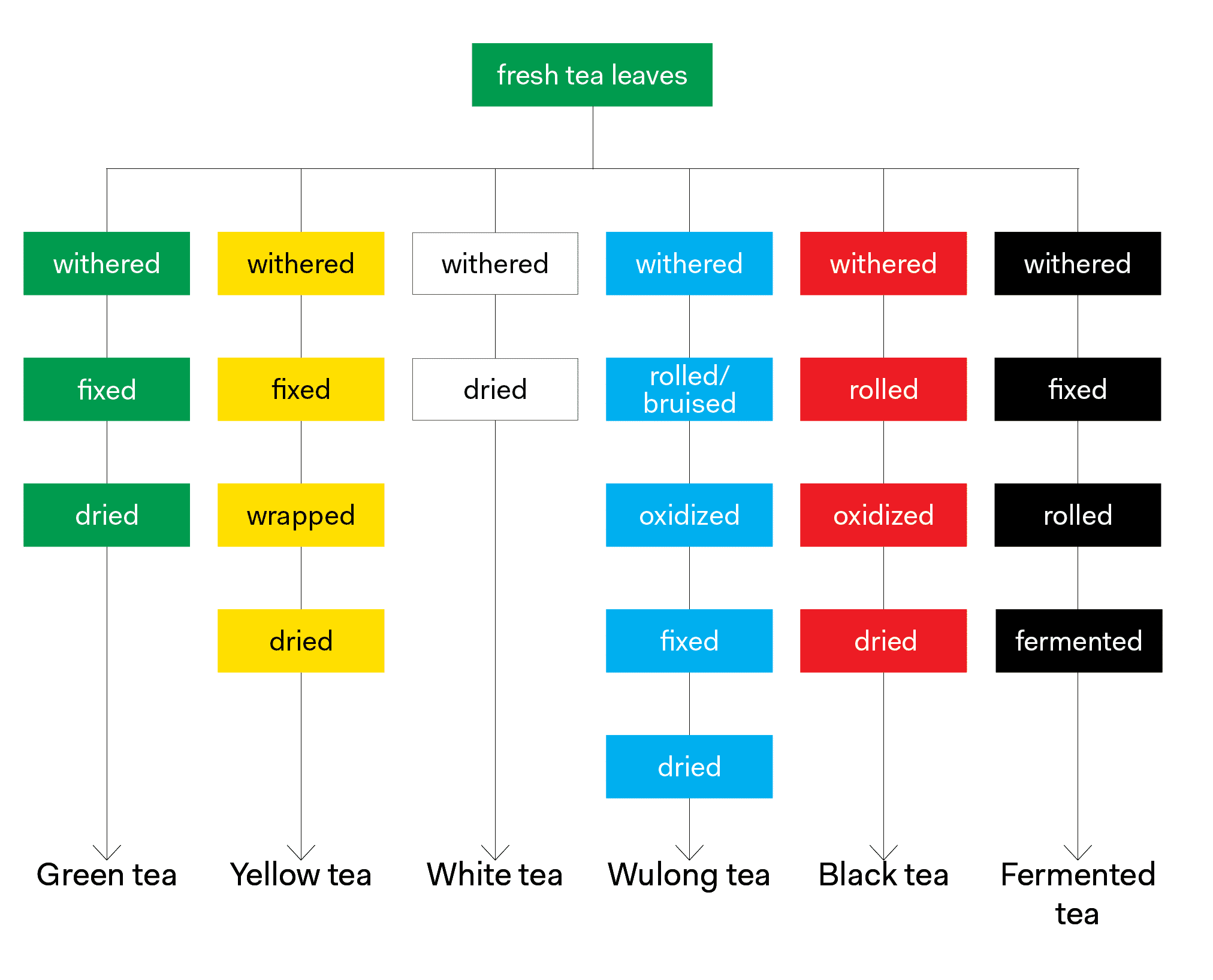
  • White, Green, Oolong, Yellow, Black and Pu-erh teas all come from the varieties and cultivars of the camellia sinensis plant and the type and style of tea is determined by the processing methods used on the plucked leaves.
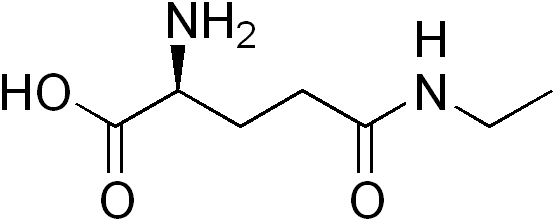
  • Tea contains L-theanine, an amino acid that promotes mental acuity. The combination of L-theanine and caffeine creates a sense of “mindful awareness.”
  • Tea can be prepared in any vessel by steeping the leaves directly in hot water as long as you strain the leaves out of the water before drinking.
  • The more oxidized the tea leaves are, the hotter the water temperature should be when steeping.

TL:

In addition to caffeine, tea contains an amino acid called L-theanine. “Several studies from Japan and the UK have shown that consumption of 50mg of L-theanine increases alpha wave activity in the brain, with the maximum effect occurring about 80 minutes after consumption. This amount is equivalent to approximately three cups of tea. Alpha waves correspond to a relaxed-but-alert mental state, and believed to be an important part of selective attention (the ability to choose to pay attention to something and avoid distraction by other stimuli)” [source: http://www.teageek.net]. L-theanine in tea produces a type of “mindful awareness” not evident in coffee. This is what prevents the 3pm “coffee crash.”

L-Theanine

Theanine

This makes tea an important tool for maintaining mental perspicacity for hours of coding, late night performance, or for getting through those bleak morning hours.

Let’s get this out of the way – tea bags suck. Actually, most mainstream tea sucks. Mainstream tea is typically low quality, blended, and sometimes contains cheap flavorings. There simply isn’t enough supply of high quality tea for the mass market. There are however, countless tea shops out there that buy directly from small farmers that produce small crops each season and likely process the tea by hand. This is what you need to find.

What You Need to Know


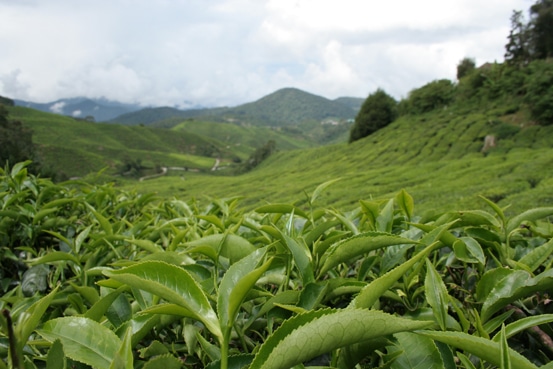
Camellia Sinensis: The Tea Plant

Camellia Sinensis: The Tea Plant

  • All true tea comes from the camellia sinensis plant [photo above]. White, Green, Oolong, Yellow, Black, and Pu-erh teas all come from the varieties and cultivars of this plant.
  • Loose tea can be steeped multiple times. Some teas can be re-steeped 20 or more times. The flavor is gradually extracted from the leaves with each subsequent steep. Many people ask how many times you can steep a tea, my answer is always: keep steeping until the flavor is gone. It depends on water temp, steep time, and tea used.
  • When shopping for tea, look for companies that offer information about where the tea is from, how it was processed, who grew it, and most importantly—when the tea was harvested.

Steep it
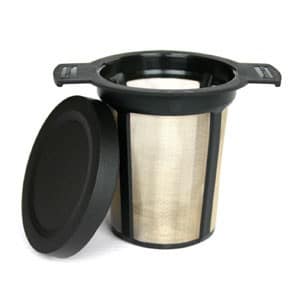
Finum Strainer

When steeping the tea, be sure the tea leaves can flow freely through the water, this rules out tea bags, tiny tea infusion baskets, tea balls, etc. Ideally, pour water directly over the tea and then strain before drinking. If you must use an infuser, a large finum strainer [photo left] works nicely and still allows for proper water flow.

Depending on the type of tea you are steeping there are two important variables you must pay attention to: water temperature, and steeping time. I’m assuming you are using good water, as tea is 98% water – using a strong chlorinated water would be a bad idea. In general, hotter water must be used for highly oxidized teas. Remember, you are preparing a drink that you should enjoy, so always take tea instructions with a grain of salt. Experiment often to discover the “sweet spot” with your teas and remember—a good tea is a forgiving tea. If your tea is bitter, reduce the steeping temperature. If your tea is too weak, increase the amount of tea leaves used or increase the steeping time.  Here are some guidelines:

Tea Water
Temperature
1st Steep 2nd Steep 3rd Steep 4th Steep
White 150-160ºF 1 min 1 min 1.5 min 1.75 min
Green 170-180ºF 1 min 1 min 1.5 min 1.75 min
Oolong 190-195ºF 30 sec 30 sec 45 sec 45 sec
Black 212ºF 1 min 1 min 1.5 min 1.5 min
Pu-erh 212ºF 30 sec 30 sec 45 sec 1 min

It is not necessary to get real serious about the steeping temperatures, for 195, boil water, take it off the stove, and wait about a minute. For 170, wait longer. Remember, experiment often.

If you want to get serious about steeping your tea, use a yixing pot, or a gaiwan. If you need energy, consider drinking matcha — a suspension of powdered green tea. You are actually consuming the leaf so the health benefits and energy received from matcha are greater than that in other teas. If you need peace, study the gongfu tea ceremony [pictured below]– it is a great way to relax so you can enjoy and appreciate the tea.
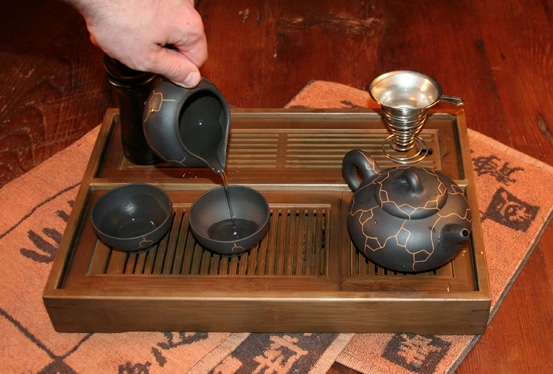
Gong Fu Tea Ceremony

Gong Fu Tea Ceremony

A fresh tea should have a shelf life of approximately two years, a lightly oxidized tea might become stale quicker. Store your tea away from light, heat air, and any strong scents. Stale tea isn’t going to kill you, it just won’t taste fresh. Some will even change and get better with age, so don’t hesistate to steep your old tea.

Read

There is a lot of good tea information out there. I highly recommend James Norwood Pratt’s New Tea Lover’s Treasury and Heiss’ Story of Tea. If you prefer an online resource, Michael J Coffey has a valuable wiki of his research here and I’ve assembled a Google Reader bundle of tea blogs. I’m currently working on a tea book myself based on this post, sign up here for updates.

I'm writing a full-length book on tea. No history, just practical tea information and SCIENCE!

74 Responses »

  1. A comprehemsive data on Black Tea. Being a Darjeeling tea drinker didn’t know most of the facts. Thanks for the steeping time. that will be helpful
    Cheers Tony,
    From the team of http://www.darjeelingteaboutique.com

  2. ChemisT at Thearubigin is a food chemist specializing in tea. She’s writing a fascinating series of posts about it. Here’s the first.
    http://thearubigin.blogspot.com/2011/10/this-is-first-in-series-of-posts-about.html

  3. Hello,
    Why the Korean Hwang Cha is the Yellow Tea ?
    What is the Yellow tea ?

  4. I never cease to be amazed at how many tea forums are. I can hardly believe that there are three comunities on this list (Badger and Blade Forums, Tea Subreddit, Tea-Mail) that I had not yet discovered.

    Thanks much!

  5. Thanks so much for creating this post! Tea is a topic I never tire of.
    Including the Wiki and Blog Bundle was a sublime touch as well.
    Keep up the great work.

  6. Great article. Thanks so much for it.
    I’m a big tea-lover and this helps to refine my humble skills.

  7. I’ve found that the sort of tea I enjoy the most, esp. in the morning, is an English brand named Yorkshire Gold, that I prepare sweet w/milk. That being the case, what variety of loose tea should I try ?

  8. Nice!

    And, let’s get this out of the way too: Blending is not inherently bad…in fact…

    • True, but it depends on who’s hands and for what reason. An artisan will blend the leaves properly, taking into account different levels of oxidation etc to produce a pleasing flavor. Mainstream, mass production “blends” teas due to a need for product uniformity across vast distances and to keep costs down. This really should not be referred to as blending rather than mashing. They’re just mashing it together and it steals the subtle differences in leaves from the end cup.

      Soil quality, temperature, nutrient content: all of these will produce different flavors in the exact same plant. It’s why regional foods tend to be wonderful, and costly. Different mineral compositions in the soils of various regions produce different flavors. A mass market tea maker will buy from many different regions and just smash it all together.

      Kind of a rambling response, but I think that touches on the important points.

    • You are right Marcus, blending is fun to experiment. I do my own blend sometimes but usually within the same category though.

  9. Wow, that was educational. I’ll try to avoid using my tea-ball from now on.

    Thanks for this article, great work.

  10. How is this a hacker’s guide to tea? Searching through google I find:
    Hacker:
    # someone who plays golf poorly
    # a programmer who breaks into computer systems in order to steal or change or destroy information as a form of cyber-terrorism
    # a programmer for whom computing is its own reward; may enjoy the challenge of breaking into other computers but does no harm; “true hackers subscribe to a code of ethics and look down upon crackers”
    # hack: one who works hard at boring tasks
    (from wordnetweb.princeton.edu/perl/webwn)

    I don’t see how any of the above applies.

    • what about a lifehacker? are most articles on hackernews about hacking? by the way — you need some serious energy to do all the programming — thats where the tea comes in.

      • https://secure.wikimedia.org/wikipedia/en/wiki/Hacker_%28programmer_subculture%29

        “In one of several meanings of the word in computing, a hacker is a member of the computer programmer subculture originated in the 1960s in the United States academia, in particular around the Massachusetts Institute of Technology (MIT)’s Tech Model Railroad Club (TMRC) and MIT Artificial Intelligence Laboratory. Nowadays, this subculture is mainly associated with the free software movement.

        Hackers follow a spirit of creative playfulness and anti-authoritarianism, and sometimes use this term to refer to people applying the same attitude to other fields.”

    • You are obviously a person with an extreme lack of imagination and have no clue about the philosophy of hackers. Hacking can apply to anything in life. It is about creativity and imagination. It is about doing things different and making them better for yourself and the world. You probably wouldn’t understand that though. You have probably watched the movie Hackers way too much.

  11. Does anyone else enjoy ginkgo tea? And can anyone tell me more about it? I watched this video and it seemed helpful:

    http://www.youtube.com/watch?v=J4bd7pO-DiU

  12. Just wanted to say thanks and great job on the article. Found it to be a wellspring of tea geekery with full linkage. You’ve energized me to revisit loose tea. Cheers!

  13. I want to put in a second vote for ‘sun tea’ brewed either over night at room temperature or for about 4-6 hours in a glass container of water left in the sun with a loose lid. Very smooth, very fragrant.

  14. This looks like more of a Hacker’s guide to Chinese Tea. I haven’t tried a lot of Chinese Green Tea or Chinese Tea in general but I do find them too fragrant and strong for my taste. I do prefer the Japanese Green Tea more though, its much more subtle.

  15. I’m an avid coffee drinker. I have nothing against tea, I just haven’t given it the chance it deserves. Thanks for this guide fellow Chicagoan! I’m going to give tea another chance. Rock on!

  16. Waiting for our shipment of estate-grown Assam as I write. BTW, English-style tea is not over-steeped. That’s a pejorative & a subjective judgment. As someone who enjoys brisk, malty Assam in the mornings and Alishan Jin Xuan green tea in the afternoon, I can say with great certainty that steeping time depends on the brew one seeks to achieve. I want breakfast tea to be strong enough to take milk and a single sugar. But I like my Jin Xuan Gong-Fu style with a quick wash and a short steep. Other than this minor issue, great post. Not if you want to get really deep, check out the history of the East India Tea Company. A real eye-opener (5th largest standing army in the world at one point, responsible for conquering Bengal).

  17. Informative! Mahalo

    What is the best way to “keep” the tea after you steeped it one or many times? You’ve provided instructions for storing the tea when dry, but how about when it’s moist?

  18. What about cold brewing? Shouldn’t that solve the bitterness problem better?

    Cold brew coffee is the best tasting coffee I’ve ever had. It’s way easier to make, but you have to start at least 12 hours in advance …..

  19. Hi guys,

    “All tea comes from the camellia sinensis plant. If you are drinking something that did not come from this plant (chamomile, mint, tulsi, rooibos, etc) it is not tea).”

    If the chamomile is not a kind of tea, what is chamomile? Normally, I drink chamomile as tea lol

  20. This is awesome! Hope you do a follow up on this and go even more into depth on different kinds of tea, their chemistry and preparations!

  21. True Hackers don’t use hillbilly units like Fahrenheit.

    • They also notice the unbalanced parens in the first bullet right off the bat.

    • Real Hackers use this:
      Levels of boiling

      shrimp eyes
      about 70-80 °C (155–175 °F) – separate bubbles, rising to top
      crab eyes
      about 80 °C (175 °F) – streams of bubbles
      fish eyes
      about 80-90 °C (175–195 °F) – larger bubbles
      rope of pearls
      about 90-95 °C (195–205 °F) – steady streams of large bubbles
      raging torrent
      rolling boil, swirling and roiling

      • I’m so glad you mentioned this. In the Hangzhou tea museum, they have a great presentation on this with big walls of different sized bubbles. This is a true tea hacker trick!

        Nice to meet a kindred spirit. I’ve spent time in UK, India, China, Japan, even Indonesia, Thailand and Cambodia sampling local tea and tea customs. I never really thought of myself as a tea hacker, but I’d have to say it’s a handle I can handle :)

        Much of the tea in the world is grown from clones, literally thousands square miles all from the same original plant. Having said that there are also teas made from wild harvested tea trees where each infusion may be quite different…

        I’d love to see some posts on Indian, Korean, Japanese teas and tea culture. For example your steep times are great for mainstream chinese tea. But I would never recommend anyone steep a Darjeeling with boiling water. Or for that matter burn a guyokuro with 170 degree water…

        I have a friend locally who is really into creating tea blends. I believe his approach is somewhere between tea hacker and tea monk. :) Seems like another area where a post or two about some great combinations might get folks jazzed up.

        One final thing, there are in fact two distinct types of tea. Both are Camelia Sinensis, the main one is Camelia Sinensis Sinensis, the less common larger leaf variety is Camelia Sinensis Assamica.

        All the best with your tea hacking!

        – Bindu Wavell
        Tea Hacker

  22. A perfect read right before I start a pot of water for some fancy tea :)

  23. 30 seconds seems very short! I make sure to leave my tea in for at least 5 minutes, old English style. I take sugar with it though.

    • Exactly… in the old English style the tea is over-steeped so that it requires sugar. With a good quality loose-leaf tea, short steepings prevent your from cooking the leaves and drawing out bitterness. You will then taste the natural sweetness of the tea.

      • Wow. i had no idea about the timing.

        I guess tea is an art. Kind of like in that Chinese movie about the war, and the boats. Shoot can’t remember it. Where the princess uses tea to delay the general???

        Anyways, cool post.

        http://tech.rawsignal.com

      • I like my tea bitter – in fact, it’s one of the primary reasons I drink it (perhaps 10 mugs on an average day). Over-bitterness is generally moderated by the splash of full-fat milk, which is itself sweet from the lactose.

        I generally find most American packaging of black tea in teabags inferior, primarily because the bags are too small and don’t contain enough tea. There’s also frequently a problem with hot water; that’s why I bring my travel kettle whenever I go abroad for more than a few days.

        But I wouldn’t be a puritan about not using teabags. A decent sized bag, especially pyramidal, normally does the trick, especially if you steep it for 8 minutes or so starting out from boiling; but the real gain is in the practicality. It’s too awkward to be dealing with pots etc. (teapots are a PITA to clean), and it’s nice not to have to worry about swallowing a bunch of tea leaves in your last gulp.

  24. I found the section on theanine of particular interest.

  25. The first TL;DR: bullet point is always a fun conversation piece. Chamomile, mint, and other herbal “teas” are not in fact tea at all. It is more proper to call them “herbal infusions.” I used to work at a specialty coffee and tea store, and we were specifically instructed to make this distinction.

  26. Really interesting read, I’m also a tea-lover. I do keep the tea’s in longer though as specified by the tea makers from India – maybe different with Chinese tea? Green tea around 2 minutes, black tea around 4 minutes.

    Please update your post with the °C temperatures you posted – international readers will appreciate it.

  27. I’ve been a green tea drinker for a couple years now, but apparently have been doing it all wrong.

    I fill two tea balls to about 25% with green tea, put them in two vacuum-insulated metal travel mugs, then bring water to just boiling (around shrimp/crab eye level), pour the hot water into the mugs, then let it sit for about an hour before drinking. I leave the tea balls in.

    I just assumed I wanted to get the most ‘tea’ out of the leaves as possible, hence letting the tea balls steep for a long time. What are the problems of doing it this way compared to your recommended shorter steeping of looser tea?

Trackbacks

  1. Tea Guide « Daniel's Rants & Raves
  2. The Hacker’s Guide To Tea | Lifehacker Australia
  3. The Married Life | I heart tea
  4. links for 2010-11-23 | The 'K' is not silent
  5. pinboard November 24, 2010 — arghh.net
  6. All About Tea « Grapefruit//Pamplemousse
  7. links for 2011-01-02 « David's Raging Nexus
  8. How to make a decent up of tea « Abhijat Saraswat
  9. L-Theanine: a 4000 Year Old Mind-Hack | World of Tea
  10. Relay: Interesting Stuff From the Last Month « Re:Creation
  11. January Links: Health Care, the Affordable Care Act Teaching Health Center, the Maternal and Child Health Pipeline Training Program, Resource Associates, and more
  12. January Links: Health Care, the Affordable Care Act Teaching Health Center, the Maternal and Child Health Pipeline Training Program, Resource Associates, and more
  13. Learning to drink (green) tea
  14. starting a tea company with tony gebely of the chicago tea garden « tea and travel
  15. Weekly Web Wandering | The Age of Will
  16. Hacker’s Guide To Tea | Apt46
  17. Japanese Green Tea: Quick Guide To The Four Main Types | Green Teas for Weight Loss
  18. L-Theanine: a 4000 Year Old Brain Secret | Brain Smart Success
  19. Wirkung von Koffein und L-Theanin im Tee | matcha.net
  20. How Tea Helps you get through the Afternoon Slump | Belight Tea

Leave a Comment

Instagram

Author

Read previous post:
Zisha Clay and Lead
Lead Testing a Cheap Yixing Pot

It is believed that some tea-ware coming from China may contain lead. Especially pots supposedly made of Zisha clay from...

Close