
Tea Processing Chart

Posted on April 25th, 2012. Written by Tony Gebely.

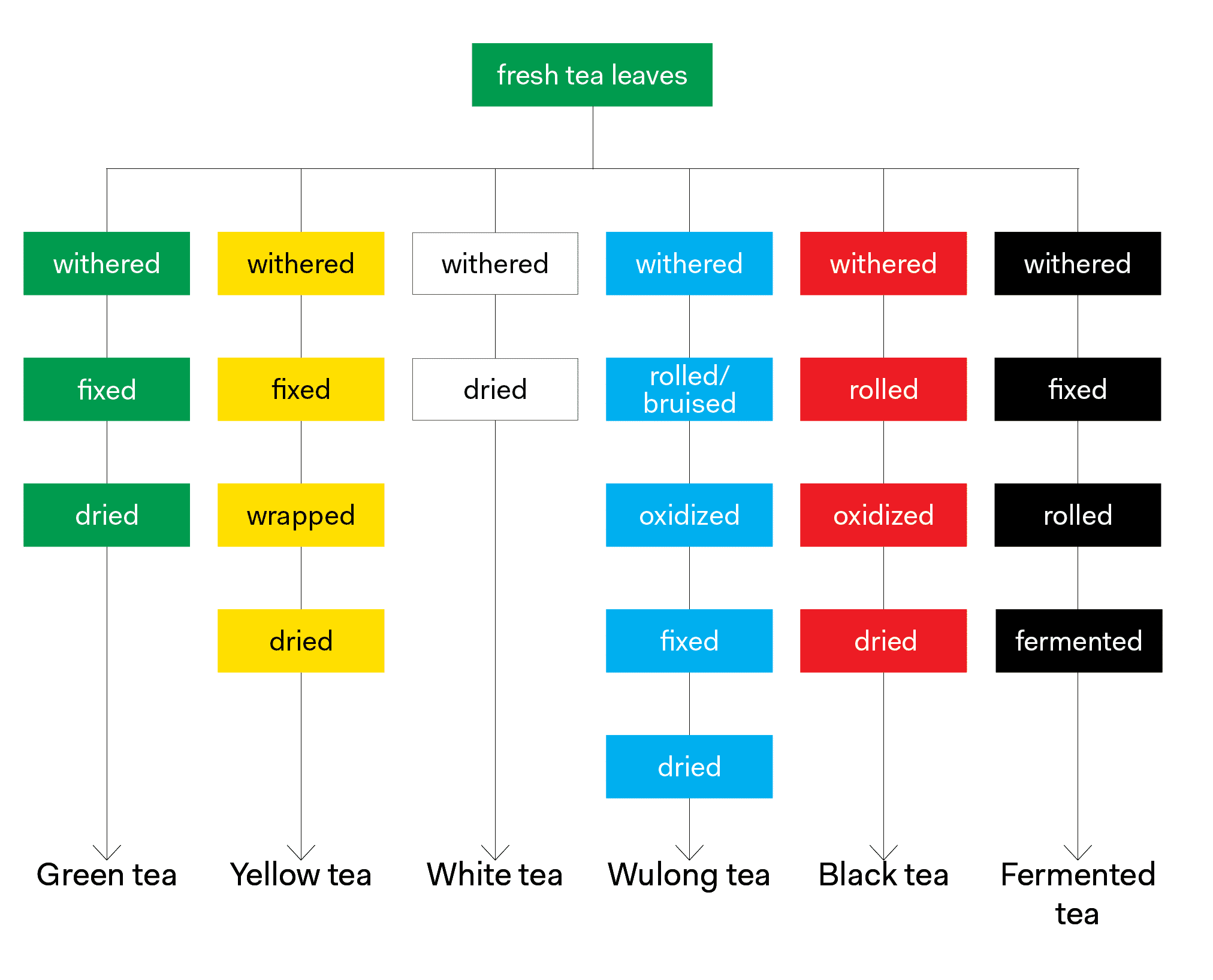
Tea processing is the most important quantifier when determining or producing a tea type. Green tea, yellow tea, white tea, oolong tea, black tea and post-fermented teas all begin as fresh camellia sinensis leaves and go through different processing steps. While there are an infinite number of variations that result in an infinite number of tea styles, the same underlying processing methodologies largely define the tea’s type. It is important to note that other factors influence the quality of a tea type for example, certain cultivars of the tea plant produce hairier buds, a characteristic sought after in the production of bai hai yinzhen, or “white hair silver needle.”  Furthermore, terroir and ultimately the level of care given to the tea plants and the leaves during picking and processing also attribute to the quality or lack thereof in a tea.

There are many tea processing charts that attempt to accurately depict the tea process, but many of them add unnecessary levels of complexity, or skip steps. The goal here was to depict  very general processes that all tea styles within a particular type would fit into. I believe it is important to begin with an overly simplified and correct processing chart and add details later on.

Another fun thing to note, is that I made this so that it would be familiar to the discerning westerner — from a Chinese perspective, the last column “Post-Fermented Tea” would be labeled heicha or black tea. The second to last column, “Black Tea” would be labeled hongcha or red tea. That’s right. We have it all wrong here in the west — but that’s a different topic.

Feel free to challenge any part of this and to share it, just please give my blog attribution. If you find this interesting, be sure to check out my posts on some of these individual processing steps: withering, oxidation, and kill green.

Tea Processing Cart: Manufacturing steps

Download JPG [3000 x 2318] [2000 x 1545] [1000 x 773]

Creative Commons License

Tea Processing Chart by Tony Gebely is licensed under a Creative Commons Attribution-NoDerivs 3.0 Unported License.
Based on a work at worldoftea.org.


I'm writing a full-length book on tea. No history, just practical tea information and SCIENCE!

8 Responses »

  1. This is very informative, and I really like your chart. The interesting part of your chart to me is that I could not find a term “rolling” there, while I often encounter them online. When I read online, I am very confusing about the sequence of tea’s manufacture steps, especially the order of “rolling” and “oxidization”. Can you help me clarify it? Thank you, Tony.

  2. For those who love experimenting herbs and teas, the chart is very helpful and accurate. The chart clearly showed the general steps involved in producing different kinds of tea. Thank you for this!

  3. I find the chart hard to read. I think it could be improved by having all boxes of the same type on the same horizontal level. That way for White Tea for instance it would have a really long line between Wither and Drying but would easily tell you at a glance which steps are skipped.

    • Thanks for the comment Michelle, I thought about doing it that way… it works well for when processing steps are “skipped” but when ones are added, for example “post-fermentation” and “bruising / oxidation” in the Post-Fermented and Oolong columns, this methodology breaks down.

      • Not if you make post-fermentation and bruising/oxidation their own horizontal steps (which only that particular type fulfills). This would in effect translate “added” steps to “skipped” steps. Also, you could argue that bruising/oxidation is actually two steps and that bruising also happens with black tea to start the oxidation process (a stronger type of bruising than for oolong but of the same purpose and nature, nevertheless).

        Also, shouldn’t oxidation take place before shaping for black tea?

Trackbacks

  1. Jackie

Leave a Comment

Instagram

Author

Read previous post:
davids_green_tea_4
Killing the Green

Have you ever wondered why Japanese green teas are so green? And why Chinese green teas are not as bright...

Close